
There are moments in life when nothing extraordinary happens—and yet everything changes.
No announcements. No interruptions. Just a pause long enough for memory to step forward and speak. These moments often arrive when we sit still, when we stop chasing answers and allow them to find us instead.
Sometimes, the past doesn’t return as pain.
It returns as guidance.
This is a story about one such moment.
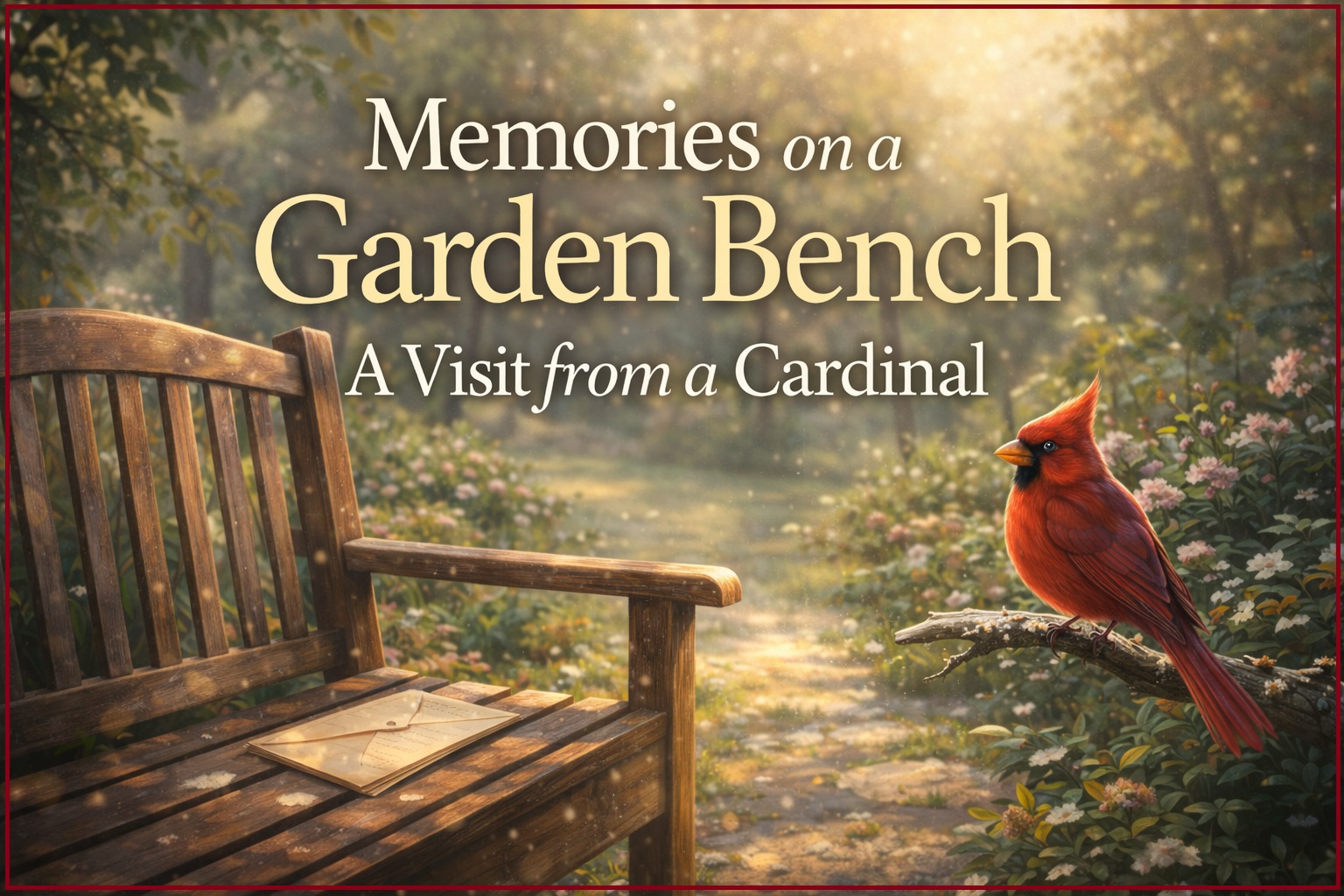
A quiet garden bench.
A red cardinal landing nearby.
And a voice from long ago—offering wisdom not through sound, but through remembrance.

The garden had grown familiar.
The same paths. The same trees. The same bench worn smooth by years of sun and rain. It had become a place of habit—a place to sit when thoughts grew heavy and silence felt necessary.
That afternoon carried no urgency. The sky was clear, the air mild, the world unhurried.
Life, from the outside, appeared settled. Responsibilities were managed. Decisions made. The long arc of adulthood was unfolding as expected.
Yet beneath the calm lived an unspoken restlessness.
Questions lingered quietly. About direction. About whether the choices made were truly aligned—or simply convenient. About whether strength had become endurance rather than meaning.
The bench creaked softly as weight shifted.
And then, something red moved at the edge of vision.
The cardinal landed without hesitation.
Its feathers caught the sunlight, bright and unmistakable against the green and brown of the garden. It stood confidently on the low stone border nearby, head turning slowly, as if surveying more than the space around it.
The sight stirred a warmth that arrived before understanding.
There was a comfort in the bird’s presence—unexpected, grounding. A sense of familiarity that felt deeper than logic.
The mind wandered backward.
There have been afternoons like this once. Afternoons shaped by slower time and patient conversation. When sitting quietly beside someone older felt natural, not intentional.
When guidance came wrapped in stories, not instructions.
The cardinal adjusted its footing.
And the memory surfaced.
The grandfather’s voice returned not as sound, but as feeling.
A steady presence. Calm. Unrushed.
He had always favored the garden. Said it was where life spoke most honestly—when you listened long enough. He believed wisdom didn’t need volume, only attention.
There had been a particular story he used to tell. One repeated more than once, especially during moments of uncertainty.
It spoke of patience. Of choosing direction over speed. Of understanding that not every season was meant for growth—some were meant for rooting.
After his passing, those words had faded into the background of memory. Life moved forward. Responsibilities replaced reflection. Advice once absorbed easily now felt distant.
Loss settled quietly.
Not as sharp grief—but as an absence that revealed itself only in moments like this.
The cardinal’s presence sharpened the feeling.
For years, reflection had been postponed.
Life rewarded momentum, not contemplation. Productivity was praised. Pausing felt indulgent.
Whenever doubt crept in, it was managed efficiently—through distraction, through work, through progress measured externally.
Remembering the grandfather too closely felt dangerous. It risked reopening questions without answers. It risked slowing down.
So the memories were kept respectful but distant. Honored, but not engaged.
Yet the garden bench offered no distractions.
And the cardinal did not leave.
As if reminding that silence is not emptiness—it is invitation.
The advice returned fully formed.
“Don’t rush past the life you’re standing in.”
He had said it once, watching birds move between branches. Said it gently, without emphasis, as if stating a fact rather than offering counsel.
At the time, it had seemed simple. Almost obvious.
Now, it felt layered.
The realization settled in slowly:
The restlessness wasn’t failure.
It was a misalignment.
Success had been pursued diligently—but meaning had been assumed, not cultivated. Strength had been practiced—but stillness had been neglected.
The cardinal hopped closer, unafraid.
The moment felt intimate. As if the past had found a way to sit beside the present, not to instruct—but to remind.
Healing did not arrive dramatically.
It came as acceptance.
Acceptance that not every lesson must be learned once. Some return when readiness catches up to memory.
The bench felt different now—not like a pause between obligations, but like a place of alignment.
Letting go began subtly—not of goals, but of urgency. Not of ambition, but of comparison.
The grandfather’s presence felt near—not as longing, but as continuity.
The cardinal lingered a while longer, then lifted effortlessly into the air.
The message remained.
Life resumed its pace after that afternoon.
But something fundamental had shifted.
Decisions felt more deliberate. Silence felt less uncomfortable. The need to prove softened into a desire to align.
Strength redefined itself—not as relentless motion, but as intentional presence.
The garden bench became more than a place to rest.
It became a reminder.
Some guidance arrives not to change your path—but to help you walk it honestly.
If this moment resonates, it’s because wisdom often finds us this way—unexpected, gentle, unforced.
Here are the lessons carried in that quiet exchange:
Guidance doesn’t disappear when people do—it evolves.
Stillness is not stagnation; it is alignment. Rushing often hides uncertainty rather than resolving it. Strength includes the courage to slow down.Advice remembered at the right time becomes wisdom. The past can guide the present without controlling it. Peace grows when purpose replaces pressure. Perhaps your own bench is waiting.
The garden did not change.
The bench remained worn. The trees stood as before. The bird did not return that day.
But something essential had been restored.
The past had spoken—not to anchor, but to guide. Not to demand, but to reassure.
Some conversations never end.
They simply wait for the right moment to continue.
And sometimes, all it takes is sitting still long enough… for a cardinal to land nearby.
FAQ
Why do memories of grandparents feel especially powerful?
They often carry unconditional wisdom and perspective shaped by experience rather than urgency.
Is slowing down important for personal growth?
Yes—reflection allows alignment between values and actions, supporting long-term peace.
How can nature trigger emotional healing?
Natural moments remove distractions, creating space for memory and realization.
What is the core lesson of this story?
True purpose emerges when we listen—to memory, stillness, and the quiet wisdom already within us.