
Noah Hale hadn’t stood on his father’s porch in almost eight years.
The wood felt the same beneath his shoes — a little uneven, a little weathered, like it refused to forget the years that had passed. The house looked exactly as he remembered: white paint fading into soft cream, porch light glowing amber, the same wind chimes his mother hung decades ago.
His father stepped out onto the porch with the same stiff posture Noah remembered from childhood — hands in pockets, chin lifted slightly, expression unreadable.
“You made good time,” his father said.
Not warm, not cold. Just… factual.
“Traffic wasn’t bad,” Noah replied.
The silence that followed was familiar. A silence with edges. A silence that seemed to say everything they never talked about.
Inside, the house smelled faintly of old books and cedar polish. His father had cleaned, clearly — the counters were spotless, a fresh stack of mail neatly sorted. For a moment, Noah wondered if the effort meant more than the words ever had.
Later that evening, Noah stepped onto the porch alone to breathe. The sun had dipped behind the trees, leaving the sky washed in lavender and gold. He leaned against the railing, letting the quiet settle.
That’s when the cardinal appeared.
Bright red, steady, perched on the wooden banister as though it had been waiting. Noah blinked, startled by the closeness.
A moment later, the screen door creaked open behind him.
His father’s voice softened — not by much, but noticeably.
“Your mother loved those birds.”
Noah turned, surprised.
It was the most personal thing his father had said in years.
The next morning, Noah brewed coffee in the kitchen, the same way his mother used to — two scoops, slow pour, gentle swirl. His father sat at the table reading the newspaper, glasses low on his nose, expression focused. The ritual was unchanged, yet everything felt different with years of distance between them.
“Coffee?” Noah offered.
His father nodded without looking up. “Thanks.”
Another clipped response. Another short bridge falling just shy of connection.
They spent the day doing practical things. Replacing a porch bulb. Clearing leaves from the gutter. Checking the basement pipes. Tasks Noah’s father approached with quiet precision, as if speaking less made the work cleaner. Noah tried small talk — the drive, the weather, work — but the conversations wilted within seconds.
It was like trying to hold water in his hands.
By afternoon, Noah excused himself and went to his childhood room. The walls were the same faded blue. The bookshelf still held the adventure novels he used to devour. Even the dent in the dresser remained, from when he slammed it shut after his father told him “not everything needs to be said.”
He sat on the bed and opened a small notebook, the one he carried to make sense of feelings he struggled to voice. He wrote about the silence — how heavy it felt, how familiar it was, how he wasn’t sure whether to resent it or forgive it.
When he stepped outside later, the cardinal was perched on the porch rail again, feathers glowing in the late sun.
It didn’t sing this time.
It just watched him — steady, calm, like it recognized something in him even he wasn’t ready to admit.
As evening settled in, Noah found himself drifting back into his old room, drawn by a strange mix of nostalgia and discomfort. The fading blue walls looked smaller than he remembered, almost as if the room had been holding its breath all these years, waiting for him to return.
He ran his hand across the dresser, pausing at the familiar dent near the top drawer. He could still hear the echo of that afternoon — teenage anger, a slammed drawer, his father’s blunt words cutting deeper than intended. “Not everything needs to be said.” At the time, Noah thought it meant his feelings didn’t matter.
Now, as an adult, he wasn’t so sure.
He sat on the edge of the bed, noticing little things he once overlooked:
the bookshelf arranged alphabetically, something his father must have done;
the posters carefully preserved instead of taken down;
the lamp bulb replaced, still warm from recent use.
Memories rose slowly, like dust in the light: moments of feeling unseen at school events, quiet dinners where conversation never grew, the weight of expecting closeness that never came.
He inhaled deeply, letting old emotions stretch awake inside him. Some were tender. Others still stung.
Later, seeking air, Noah stepped onto the porch again. The cardinal was perched near the window, its red feathers muted in the dusk but unmistakably present.
It tilted its head toward him, unblinking.
Noah exhaled, a breath he hadn’t realized he’d been holding.
The bird didn’t offer comfort.
It simply mirrored the silence he had carried for years — a quiet witness to the stories he never voiced.
The next morning, Noah woke earlier than usual to the smell of freshly brewed coffee. His father stood at the kitchen counter, pouring two cups with meticulous care. It was the kind of gesture that didn’t declare affection out loud, but traced its outline quietly.
“I made some for you,” his father said, sliding a cup across the table.
“Thank you,” Noah replied, surprised by how natural the moment felt.
They sat in a silence that wasn’t hostile — just fragile, like something new trying to form. Outside, soft light filtered through the window, casting gentle shadows across the table.
Noah was halfway through his coffee when his father spoke again, his voice lower than usual.
“Your mother… she used to wake up before sunrise,” he murmured. “Said the birds sounded kinder in the morning.”
Noah looked up slowly. It was the first time his father had mentioned her in years without shutting down.
“She loved cardinals most,” his father added, stirring his spoon in slow circles. “Said they were reminders to pay attention.”
Noah swallowed, unsure what to say. He had never heard that detail — never seen this softer layer of the man who raised him.
“She noticed things I didn’t,” his father continued. “Still miss that.”
The vulnerability in his voice tugged at Noah’s chest.
They didn’t talk long. They didn’t dive into grief or the years between them. But something shifted — a quiet doorway opening, small but unmistakable.
When Noah stepped outside afterwards, the cardinal was perched on the railing again, closer than before.
And for the first time, Noah didn’t feel observed.
He felt… accompanied.
In the late afternoon, Noah’s father asked if he could bring down the old holiday decorations from the attic. It was a simple request, practical as always. Noah agreed, climbing the narrow wooden stairs that creaked beneath his weight.
The attic smelled of cedar, dust, and time. Light filtered through a small window, catching floating specks like tiny drifting memories. Boxes were stacked neatly — his father’s orderliness present even here.
Noah found the holiday bin easily, but a smaller box tucked behind it caught his eye. It was labeled in faded marker:
NOAH — KEEP
His breath stalled.
He pulled the box forward and opened the lid. Inside were small pieces of his childhood he didn’t even remember keeping. But his father had.
- A drawing of a blue house with crooked windows — Noah’s first grade art project
- A report card with “excellent effort” underlined twice
- A plastic medal from a school fun-run he barely finished
- A tiny, chipped toy car he swore he’d lost forever
At the bottom lay a folded program from Noah’s middle-school band recital. His name circled in careful pen strokes.
Noah’s chest tightened.
He had spent years believing his father never noticed — never cared — yet here were the quiet proofs of a man who held on in the only way he knew how.
He sat back on his heels, overwhelmed. The attic felt softer, warmer.
Outside the small window, as if keeping vigil, the cardinal perched on the sill. Its red feathers glowed in the fading light.
Noah didn’t touch the window.
He simply looked back, understanding dawning gently, painfully, beautifully.
He had been seen all along.
Just not in the language he understood then.
Noah carried the box downstairs slowly, each step heavier than the last. His father was in the living room, sorting through a drawer of tools. He looked up briefly when Noah entered.
“I found this,” Noah said, setting the box on the coffee table.
His father hesitated. Just for a moment. Then he removed his glasses and rubbed the bridge of his nose — a small gesture Noah hadn’t seen since he was a child.
“I meant to give that to you someday,” he said softly.
Noah sat across from him. The air felt thick, like the house itself was waiting to hear what came next.
“Dad… why didn’t you ever say anything?” Noah asked. “Why didn’t I know you kept all of this?”
His father’s eyes lowered. “Because I wasn’t raised to say things.”
He paused, searching for the right words.
“My father… he wasn’t gentle. He didn’t show pride. He didn’t show grief. He barely showed anything. I swore I’d be better… but I didn’t know how.”
Noah felt his breath catch.
His father continued, voice steady but fragile:
“I watched you grow. I kept things because I was proud. I fixed your room because I paid attention. But speaking it…”
He shook his head.
“I was afraid I’d fail the moment I tried.”
The confession settled over them like soft dust.
Noah wasn’t angry. He wasn’t relieved. He simply felt the truth — heavy and human.
“It wasn’t rejection,” his father said quietly. “It was fear. And I’m sorry you carried the misunderstanding.”
Noah nodded slowly, heart aching and softening all at once.
Outside, the cardinal glided to the porch railing, its silhouette framed by dusk — a still, red witness to a moment decades overdue.
The next morning carried a quiet that felt different — not heavy, not tense, simply… open. Noah found his father on the porch, tying the laces of his worn walking shoes.
“Going out?” Noah asked.
His father nodded. “Thought I’d walk the old trail behind the park. Haven’t been in a while.”
A pause.
“You’re welcome to join.”
It wasn’t a grand invitation.
But it was more than Noah ever expected.
They walked side by side down the familiar path, the air cool and carrying the scent of pine. Fallen leaves crackled under their steps. For a long time, neither spoke — and for the first time, the silence between them didn’t feel like a wall.
Halfway through the trail, his father slowed.
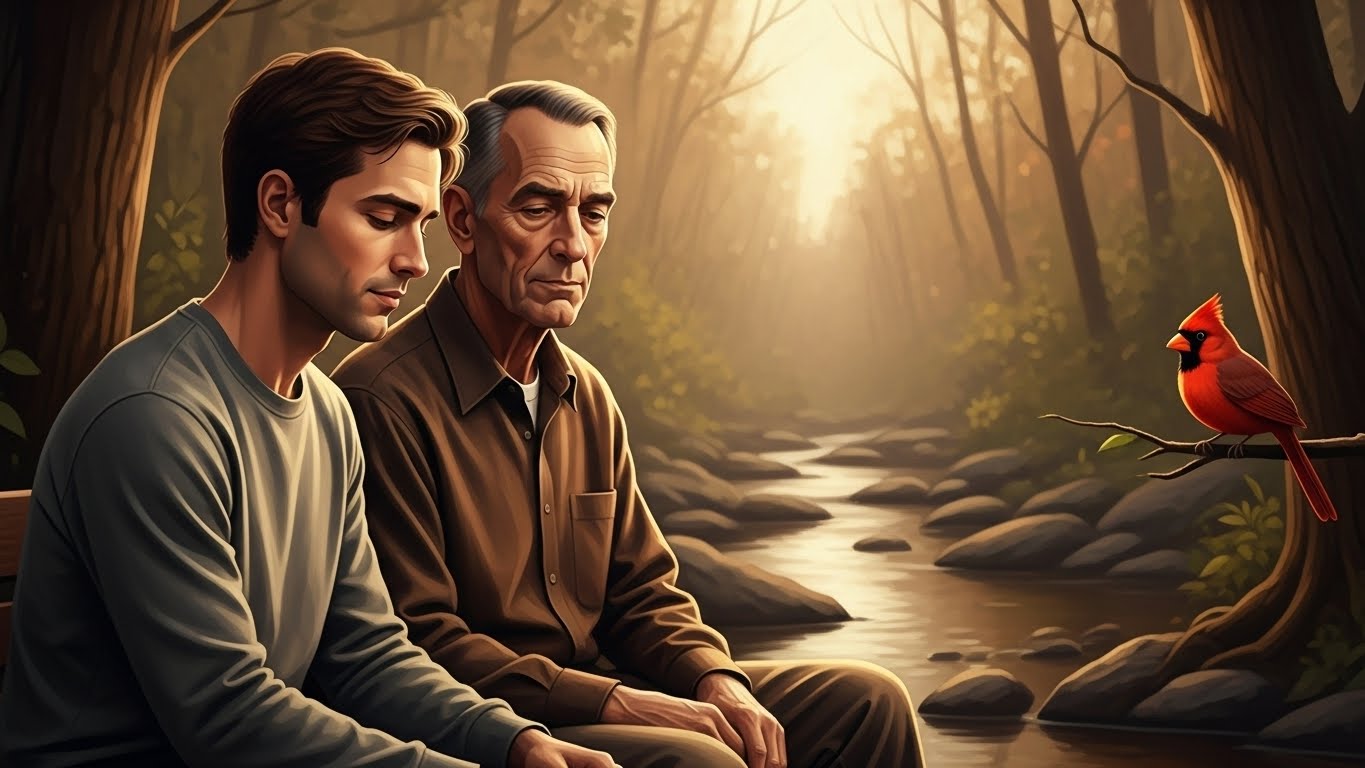
“You used to come here after school,” he said. “Sit on that old bench near the creek.”
Noah blinked. “You… knew that?”
His father nodded. “Saw your shoes by the door. Muddy. Always the same pattern. Figured you needed space, so I let you have it.”
Warmth spread through Noah’s chest — bittersweet, tender.
They reached the bench, weathered but standing. A cardinal fluttered onto a nearby branch, hopping lightly along the limb as if accompanying them.
His father watched it for a moment.
“Your mother believed cardinals showed up when we needed a reminder. I never knew if she was right… but maybe she was.”
Noah smiled quietly.
In that small moment — no dramatic confession, no sweeping apology — something softened between them. Understanding didn’t arrive in words, but in presence, shared steps, and a red bird perched nearby.
Sometimes peace begins exactly like that.
That evening, Noah and his father returned to the porch just as the sky shifted into a gradient of rose and deepening blue. The old wooden boards creaked under their weight — the same familiar sound from Noah’s childhood, but now it felt grounding instead of unsettling.
They sat without rushing to fill the space.
Two cups of warm tea.
Two generations of quiet men learning the language of peace.
His father rested his hands on his knees. “I wasn’t always fair to you,” he said after a long moment. “But I’m glad you came home.”
It wasn’t a grand speech.
It wasn’t perfect.
But it was real.
Noah felt something inside him loosen, finally. Not erasing the past, but giving it room to breathe.
“I’m glad I did too,” he answered.
The wind moved gently through the chimes. The porch light hummed. And then, from the edge of the yard, the cardinal appeared once more — gliding onto the railing with quiet purpose. Its feathers burned warm against the twilight.
The narrator’s voice gathers the meaning softly:
1. Sometimes we spend years searching for the right words, only to learn that presence speaks louder.
2. Not all parents were taught how to love in ways we could understand.
3. Forgiveness doesn’t erase history — it simply frees the heart to move forward.
4. Peace often arrives in small, humble moments: a walk, a memory, a shared silence.
5. And sometimes a red bird reminds us that understanding takes patience… and time.
As dusk settled fully, the cardinal lifted into the air and disappeared beyond the trees.
Noah watched it go, feeling something steady and warm settle inside him.
He didn’t get the father he once wished for.
But he found the one he could finally understand.
And in that, there was peace.